Rescued by a Dapper Alchemist, a Competitive Markswoman, and a Lion-Headed Wrestler, Marina has one task. Escape The New Player Experience!
Saturday, April 8, 2017

It’s Dangerous To Go Solo! A case for Ensemble Casts in LitRPG
A week ago, I saw a huge “kerfuffle” erupt over the comment thread of a LitRPG review where the term ‘Male Power Fantasy’ was introduced to the conversation. ‘Male power fantasy’ is a tricky term that’s used both as a necessary caution to established authors, but also a pejorative term for those who just want to sling mud and bait aggro. As with most divisive terms such as this, it’s easy to be interpreted in a myriad of different ways due to passive aggression but I’d like to weigh in on the narrative issues perpetuated by Power Fantasies for sake of establishing why I’ve made the decisions I’ve made with what will hopefully be my upcoming SciFan magazine serial: Immersion.
This is a personal and biased opinion, but while I don’t believe Male Power Fantasies are harmful for merit of just existing, the problem that I have with them is that I’ve never really found them to say anything differently from one story to the next. Power Fantasy stories don’t seem to be told by an author so much as being retold over and over.
The problem with Power Fantasies isn’t that they exist. because I totally understand and appreciate formulaic stories which are created for the sole purpose of delivering essentially the same payoff every iteration. I am a fan of Marvel Movies and I can tell you exactly what equation they follow and slowly weep like a small child since the New Spider-man movie illustrates this equation without a hint of an attempt to hide it- but I will do my best to maintain my composure long enough to finish writing this post.*
The problem, once again in my biased opinion #disclaimer, is that the Power Fantasy MC has the most agency out of any NPC (or sometimes even other player characters) and the writer has consolidated the roles of multiple characters into the MC to the point where MC now monopolizes all the force of will in this story’s universe.
The reason why I’m being so specific is that, funnily enough, I would say that LitRPG is the genre where Monopolization is MOST NOTICEABLE. Not because of “Gamergate”, “SJWs”, “Women”, or “Fake LitRPG Authors posing as Reviewers to get rich?????” but because the authors will painstakingly establish a meta... only for their MCs to BREAK it!
Once again, for sake of disclaimer. I am not intending to come off as cruel or harsh, I’m relaying exactly what happens in many stories according to negative public reviews. Also, on a mechanical level I understand what happening with the author. They see that they’re character is falling into a repetitive funk because he’s alone or MVP of the team so they have to immediately change approaches for sake of the health of their storyline.
How often have we seen MCs who conveniently switch classes, gain abilities they aren’t intended to have, or completely/permanently invalidate their own weaknesses through necessity of the plot rather than the ingenuity of their own quick thinking for that one-off scenario?
The list goes on but I’m not trying to be mean, so I’ll cut it there.
This isn’t a problem with gender equality and it isn’t even a problem restricted to one gender (Mary Sues are just as guilty but in LitRPG they are woefully outnumbered so this complaint doesn’t occur as frequently- but it does occur).
The reason it is a problem to have an Power Fantasy MC in LitRPG is because:
1) These are traits or activities which others characters could be doing while your character continues to do their own thing! Your character can be as strong as you want with whatever skill you choose and bang as many people as you deem appropriate but if they’re doing everything perfectly all alone it tends to destroy suspense or a sense of peril. There’s a reason Kirk, Spock, and McCoy are different people and have different fanbases: together they’d be the worst Gary Stu imaginable but separately they are memorable and ICONIC. More so, the gap of morals/temperaments between them actually sells their individual characteristics that much more!
2) The tutorial sections explaining game mechanics or exhibiting stat sheets are usually daggers in the eyes of people who aren’t into LitRPG because they aren’t predisposed to the author stopping the events of the story just to tell them everything they need to know about the game before the MC can go about their adventure. I know it’s a mark against an author to cater to readers who aren’t part of our ‘core audience’ but that doesn’t mean that we can’t try and take up a challenge for sake of changing up the writing meta a little. Something as simple as having another person for the MC to bounce ideas off of or instruct the MC would be welcome as opposed to unnatural vocal narration from the MC on top of usually sufficient narration from the author.
3) Other characters can reinforce mythos more reliably than the readers simply being told by the author why a power is useful, a villain is scary, or a weapon is meta/garbage. I think a lot of people cite “anime” as a huge turnoff when it comes to LitRPG but I believe that the intention is positive, it’s just that authors aren’t taking the correct lessons from anime. That sounds crazy but please hear me out!
For instance, a lot of Anime comes from Manga, or comics for those who don’t know. The comics are obviously still-frames depicting motion. In many early cases with martial arts manga, the artists and writers would rely on a side-lined character to narrate to the readers exactly what was going on in the panels so that the reader would know how to interpret the image. When the Manga is adapted to Anime this convention stuck because this side-line narration helps to “sell” the gravity of a fight, but admittedly in today’s anime it’s a little unnecessary since we can see the fight for ourselves. The side-line narrator is just a trope that has become synonymous with martial arts anime and they are included because it’s simply a part of the story at this point! And I love that!
In LitRPG though, this convention of side-line narration is born anew since we not only sometimes require context for what’s happening on the printed page, but there’s often game meta associated with what’s happening as well. Having a teammate who can convey this would be a great workaround if you want to avoid plot dumping a lot of chunks of text to readers. Combine this with the appropriate characterization or set precedents prior to the fight and the side-line narration can actually sell your game mechanics a lot more than the writer just stating it plainly.
In the spirit of “perspective” discussed in my previous post, here’s an excerpt from the interplay between the ensemble cast in Immersion, a serial I’m hoping to get published in SciFan Magazine. This by no means is a universal solvent that’s meant to be take as a commandment of literature, it’s merely a workaround I had fun developing.
I hope you have fun reading it too, and then I’ll break it down after.
====
Ken hopped back to the control panel and proceeded to initiate the unlocking sequence. He reminded everyone with a hint of aggravation in his tone, “Alright so when I free her, the alarms are going to be triggered and ‘New Player Experience’ or not, reinforcements will most likely be called in due to our collective player rank. From there it’s simple enough: We cheez it through the excavation site and cross the finish line to end the mission.” He added while looking up at nothing in particular, “Does everyone remember what they’re doing?”
Dagny, now comparing the the alien weapons to her own rifle, replied without looking up, “Flanking as usual, easy-peezy.” She added under her breath, “If Rowan can be bothered to join us, anyway.”
Via comms, a Gaelic cadence replied with painstaking focus, “I’m opening my chakras and attaining Nirvanic Enlightenment, dear wife. Just another few minutes and I’ll be there to carry your fine ass across the finish line with time to spare.”
Ken looked into the viewing window of the cryogenic pod again, “And you?”
“I’m sticking with you. If we get separated then I always make a bee-line to you.”
Ken smiled, “Copacetic!”
“So, I know I’m new and all, but you mentioned these New Player Experiences were procedurally generated based on player rank. And you also said that player rank factored in previous game saves from earlier installments for additional perks and challenges. Doesn’t that mean we’re on extra hard difficulty since we’re all coming from previous saves?”
Ken shrugged, “The perks are just randomly assigned abilities or spells from previous games that are discontinued-”
“Until DLC.” Dagny and Rowan added in unison.
“Until DLC.” Ken rolled his eyes and continued, “As far as difficult? It won’t be if we stick to the plan. Dagny’s prioritizing special targets like casters or ranged fighters with her sniper rifle, Rowan’s face-tanking everything within reach and drawing aggro away from the rest of us, and I’m facilitating both of them with my alchemy while escorting you.”
Dagny added with resignation, “Basically, whether we succeed or fail is completely dependent on whether you can keep yourself out of trouble. Don’t screw this up for us, noob.”
Rowan assured calmly, “That’s Dagny’s way of saying that you can count on us to protect you so don’t feel the need to worry about anything other than crossing the finish line!”
Ken added casually, “Besides, we always have Plan X.”
Dagny furrowed her brow upon recalling the so-called ‘Plan X’, “Wait that’s seriously on the table?”
Ken looked back to her with a shrug, “I mailed you the tracking beacon before we left.”
Rowan replied as softly as he could between long, measured breaths, “I missed something, what’s Plan X exactly?”
Dagny struck her rifle onto the ground bayonet-first and leaned against the stock while looking to Ken incredulously, “The one where we use our ship to commit suicide!
Ken indicated via a euphemism before the newbie could ask questions he wasn’t prepared to answer, “Plan X is the one where we bring the finish line to us-”
“Wait we have a ship?”
Ken winced, “Y-yes. I wanted that to be a surprise.”
The smile evident in her voice, she gasped, “Like in Wind Waker?”
Rowan calmly pointed out, “That’s actually an apt descriptor!”
“...Does the ship have a name?”
Rowan muttered, “Here we go-”
Dagny protested, “No, it doesn’t-”
Ken declared proudly as Rowan began to laugh, “We call it: The Antares!”
“That’s so cool!”
Dagny finally shouted, “Okay Everyone shut up! Is no one else freaking out because our contingency plan is something our Quartermaster saw on ‘Rooster Teeth?”
“Youtube wouldn’t lie to me!” Ken retorted with mock-outrage-
The newbie finally blurted, “Okay seriously, I would like to have a body again please.”
Ken turned his attention back to the console, “Right. Sorry Mina.”
===
Mina is the MC stuck in the cryopod waiting for her boyfriend to free her, meanwhile Rowan is off doing something crucial to prepare to Tank for the group and Dagny is clearly not happy to be there. Each of their personalities the relations thereof are established and each are mechanically playing a role to the story while advancing it where it needs to be prior to the main action taking place (an excerpt which I will post in roughly 20 minutes as a payoff for sitting through these posts).
As MC, Mina/Marina asks questions the reader would ask but is clearly enthusiastic to be there. Her excitement and wonder over the gameworld is something I hope will be shared with the reader as they follow her on her journey.
Ken guides her to a very overprotective extent, but proves that while his knowledge of the game may be encyclopedic, he’s also very unreliable in the way of sound logic. That unpredictability could just as easily be a source of safety or danger and there’s no certainty which way that will go. He establishes a sense of peril despite also being a source of comfort.
Rowan positively reaffirms the strategies and personalities he is opposite of. He’s happy to be there, is calm, cool, and competent. He’s their rock and so if he expresses confidence then the reader should feel that he’s trustworthy to lead them the correct path.
Conversely, there’s his wife Dagny. Who while unreasonably negative for her own personal reasons, provides just enough resistance so that characters are given a reason to concisely explain otherwise complicated ideas while she also sells the peril involved on those concise ideas. Due to her blunt nature, characters often respond simplistically or sarcastically, thus removing another layer of unnecessary complexity to those game mechanics and making the exchange more of an illustration of humor than an overwhelming block of exposition being force-fed to you.
As said before, I want Immersion to encapsulate the benefits of perspective and what that affords a team of like-minded people as they slowly begin to drift toward their own personal goals. As foreshadowed in Control Alt Sadit, these people will also be stuck in the game at some point and so that interpersonal dynamic will also have to withstand the test of pressure as they are forced to work together to make sense of a procedurally generated universe where science fiction and fantasy co-exist.
And now for the payoff to this horribly long post I’m steadily editing down as we continue into the latter half of our hour. Big thanks to Blaise for not beating me with a sock full of batteries yet. In 10 minutes I’ll include an action packed preview for the upcoming Serial Immersion followed by our send off post to close out the hour.
Thanks everyone!
Building Rapport with Villains: The Tragedy of Impasse
One thing that has always struck me as a little off about the depiction of villains in mainstream media is that they’re often defined by their actions, by the ways they are a foil to the protagonist of the story, or ignored in favor of the actors who portray them. It’s very seldom that they are depicted to the audience as genuinely endearing or even trustworthy.
In the universe of Eidolon, we’ve been introduced to one villain in the way of Sadit who genuinely chooses to do things that he knows on some level are wrong in exchange for personal enrichment. Depending on who is reading the story, what Sadit is after will be interpreted differently. The interpretations are all valid, but my core intention was to play with a writing mechanic I don’t see utilize that often.
I’m not sure what the academic term for the mechanic is, but I refer to it as “Building Rapport”.
In the previous post, I touched on the idea that the crucial factor of Sadit’s own motivations was that he was emotionally disconnected from his family. But on a more mechanical level, by understanding where he’s coming from, it gives weight to the actions he takes to get where he’s going. You don’t have to come from an emotionally distant family to relate with him, you just have to see what he had to deal with and follow the chain of events he takes in order to get away from it.
You see, this lends credence to the motif about miscommunication. No one else knows what Sadit’s emotional state is or what brought him to the game in the first place, not even his own family. Even his own ability to relate with people in a game he’s dying to play must be filtered through the “Dalek” Voice mask so that he can assume the role of a person who he perceives is worthy of paying attention to.
These personality defects represent something I’ll refer to as a ‘grievance’. A grievance is a problem a character will have which is a motivating factor for them, but mechanically allows a foothold for the reader to understand the mindset of said character. My Villains tend to have grievances rather than explicit motivations. The motivations will usually be revealed down the line, but the grievances will always be featured first so that they can build rapport with the reader.
In Control + Alt + Sadit, readers get the benefit of understanding Sadit on a level no one else really does. The irony there is that we cannot talk back to him. Whether the reader’s feedback would be consoling or critical to Sadit, my hope was that this would instill a level of frustration in the reader to know what it was like to have a genuine idea of what needed to be said but be powerless to convey it in a way to incite constructive change. This mirror’s Sadit’s plight of depression and lack of self worth, but being unable to communicate those grievances in such a way that would get him the help he needs. This way of the villain and reader can identify with one another without actually relating or agreeing 100%.
This level of rapport (positive or negative) between villain and reader is something I want to achieve with every main ‘big bad’ who’s introduced.
So when Damond Andrews is brought into the forefront, because this is a LitRPG of course he will, I will attempt to do the same with him. My intention is not to fall into a formula, but to give weight to his own decisions and not simply leave them as open-ended acts of villainy or a catch-all GOD COMPLEX motivation.
But why? Some may ask.
Why can’t we just have villains be villains?
Well, Eidolon is a game and we will have plenty of monsters and NPC faction leaders who will fill that void, no worries. I want that just as much as the next person and I have fun writing that.
As far the point of lending credibility to main big bads though?
I do it because I want to illustrate the tragedy of an impasse between opposing forces who each possess a VALID grievance. In fact, I’d go as far as to say that if “Control + Alt + Sadit” was about the plight of miscommunication, then my serial “Immersion” will be about the benefits of perspective. By seeing all of these groups of characters and what they’re striving for, and how those actions get them closer and farther from what they want and where they intended to go, that’s where the story unfolds. I may convey that narrative with game mechanics, epic fights, lore, and humor, but at it’s the core that is the story I intend to tell.
Or in other words, each of these characters possess a story which is represented as a dot. Insignificant alone, maybe, but when we zoom out to view all of these stories put together these insignificant dots form a mosaic which paints a portrait resembling a bigger picture. Those dots represent characters but the grievances are the connective tissue which makes the portrait recognizable when we wind back.
Like I stated before though: I don’t claim to have solutions, only workarounds. When dealing with an ensemble cast with so many perspectives, there lies another can worms that needs to be opened for better or for worse. Which is a subject for my next post "It's Dangerous to Go Solo! A case for Ensemble Casts in LitRPG".
"Magical Fairy Stories"
A few months back when I was researching the ins and outs of LitRPG, I was listening to an interview between the most reliable sources an aspiring LitRPG writer can find. At one point one writer touches on some of the more unsettling content that they write and the second writer states that it’s that level of discomfort that separates adult literature from kid literature or “magical fairy stories”. This prompts the first writer to share an anecdote about when parents ask them if their kids can read these stories they write. This writer say that they always have to let them down and inform them that although they do write about video games, that literature is geared toward adults. The two then discuss how real life consequences are what make LitRPG compelling, realism is preferable to “pandering”.
In my biased opinion, it seems like a missed opportunity when an author seems to want to appeal toward a more realistic tone instead of taking advantage of the more imaginative qualities that the setting of a video game can afford them. Which in my opinion, is an untapped strength which LitRPG has over many other genres out there. *Versatility is our advantage* and yet we feel compelled to restrict ourselves so that we can prove how adult we are in contrast to the perception of the source material by the general public. To aspiring writers: If there’s a mature story to tell then go for it, but if you’re ascribing to it to prove something to someone you’ve never met then think twice. You may have a better story to tell, give yourself a chance and don’t be defeated before you done anything less than that.
There are consequences in my stories, sure, but my emphasis is not on the macabre. It is on the triumph of that adversity being surmounted, the actualization of an underlying moral being unveiled, or even that loop that was started at the beginning of the narrative being concluded with sufficient closure. That is what I refer to as a ‘Payoff’. The reader invests their time into my story after following the hook a the beginning and it’s my obligation as an Author to provide a sufficient Payoff for their time.
And in order to get to that Payoff, I would much rather use the ‘wrong’ perceptions of video games as a baseline for the general public while gearing the narrative for teenagers and then progress the narrative from there once everyone is on the same page toward a story they didn’t think would work in that type of format. However, no matter how wild or fantastical that deviation may be, I employ another writing mechanic to ensure that it’s snared back on track toward the third act of the story. The Moral of the story.
And in order to get to that Payoff, I would much rather use the ‘wrong’ perceptions of video games as a baseline for the general public while gearing the narrative for teenagers and then progress the narrative from there once everyone is on the same page toward a story they didn’t think would work in that type of format. However, no matter how wild or fantastical that deviation may be, I employ another writing mechanic to ensure that it’s snared back on track toward the third act of the story. The Moral of the story.
This is another distinction between Adult Literature and Kid Literature. An overt message of a moral being illustrated within the plot. Adult Literature speaks more to the illustration of decisions made and the toll it takes on it’s characters, usually committing entire chapters to those characters coping with the gravity of their actions.
Kid literature does the reverse of this. It tends to illustrate the various choices at hand, illustrate how terrifying the stakes of this choices are, and then usually will involve a mechanic that will stop the progression just before irreparable damage can be made (Thus why it is described as a “Magical Fairy Story”) BUT in lieu of the play-by-play of something terrible happening to a good character, we instead receive a denouement or even falling action which conveys the overall moral intended to be illustrated in this kid literature. Then and only then does the consequences of those choices sink in, and the character will usually carry on with their resolve strengthened rather than broken to contend with the new status quo. I’ll agree, if this is handle lazily (Deus Ex Machina) it can trivialize the previous events of the story and invoke cries of ‘plot armor’. But if the realization of the moral closes a loop, involves a resolution the characters have EARNED, and contributes to character growth which will have agency in stories to come. Then I feel that is a valid story. You got three acts, a character arc with weighted choices, and progression if not a conclusion for the ongoing plot.
Another deciding factor in appealing more to ‘Kid’ Literature rather than ‘Adult’ Literature, is that the expedited mechanics to wrap up a story while still leaving loose threads for an ongoing plot are more conducive to an ongoing series of epic novels. A big complaint I see frequently about Adult LitRPG Novels is that they sort of meander with little to no resolution while building upon the complexity of their world or game system all the while. If you’ve ever read a book where the characters will take plot detours because another quest suddenly arrived, that’s what I’m referring to. When I decided to pursue a Serialized LitRPG Story, I knew I wanted to make installments that each ended satisfactorily for the reader rather than just twist a knife at the end of every story and declare “Your Princess Is In Another Castle! Pre-order it HERE!”. The best way to provide resolution was to establish a moral toward the end of each installment. So that way, even if the main plot doesn’t progress to a conventional stopping point, you do feel that you’ve still read a full arc of a character or a place. Thus your investment is paid off.
In Ctrl Alt Sadit’s case, the moral is that no matter how correct you are, it does not give you license to be unaccountable for your own actions. Sadit’s understanding of this lesson by SPOILER is what ultimately redeems him whilst his ‘friends’, who do not see it that way, are left to face their fates elsewhere. The notion suggested here is the foundation to another less-surface “Ray Bradbury” inspired motif I’ve always wanted to touch on in a story: the plight of miscommunication in an age where communication is expedited beyond all expectations!
There’s one scene in particular just after the beginning when Sadit’s punished at school and is riding home with his father. Both are sharing in the frustration that Sadit may have to face alternative school for getting into a fight, but while his Father is yelling into his bluetooth, Sadit is doing the normal LitRPG trope of “This is the game I love, pay attention to it’s important exposition and mechanics”. However, the REAL point of this scene is that the entire time, and in fact through the entire course of the story, Sadit’s father never actually speaks to him personally!
Sadit’s Father never chastises him, he never encourages him, he never consoles him. He’s upset he may have to drive to a disciplinary hearing the next morning, but it’s just incidental that it involves his son.
Sure, his father talks to the principal, Sadit’s mom, Sadit’s brother, his co-worker, etc. But never in that story is there an exchange of dialogue between Father and Son. And when we see Sadit’s actions later in the story and how easily he is manipulated into doing really foolish actions for sake of camaraderie, we can kind of empathize with him in spite of the fact he is the villain of his own story. That achieved because we’ve actually taken the time it understand where he’s coming from (more on that in my next post in 10 minutes).
To me, it’s that level of interpersonal nuance between characters that often gets dismissed because it’s not a conflict represented directly in the gameworld with charts or numbers and it’s not considered a ‘grown up’ problem since it isn’t like Sadit is a murderer, he’s just troubled and borderline depressed. The “mundane” nature of those personality problems are what run the risk of the core audience being upset because I committed time to that when I could have been spending that time developing the gameworld instead. Which means that if IRL content eclipses the game content then that would hurt me as an author because clearly I’m fake and trying to make money by cashing in. This is why that detail was snuck in there and why usually I’ll sneak these little nuances rather than emphasize them at expense of the game portions themselves. If you’re not looking for them then you won’t be at any loss for the enjoyment of the story. If you ARE looking for them, then keep your eyes peeled. I put them everywhere.
And don’t get me wrong, I do the same on the gaming side of the story as well. It’s a thinly veiled reference that Sam’s min-max Nomad is representative of Destiny’s Titan and the Ghalaton is in fact the Meta-mandated Gjallarhorn. It’s a little more ambiguous but ‘The Magician’ is also supposed to be Loki from Warframe using his most ‘garbage tier’ ability ‘Switch Teleport’ to outpace The Titan. I honestly have had that bazooka vs. space ninja stand-off choreographed in my mind for years but never had an outlet to showcase the fight until now. And it was damn fun to finally put that to paper, more less have the opportunity to publish it!
But that’s what it comes down to. I never feel uncomfortable when I write the things I write, I have fun with it. I enjoy what I do and if that fun can be relayed to the reader, no matter their age or maturity, then I’m proud to be the author of magical fairy stories! I want to make the reader happy.
Friday, April 7, 2017
Control + Alt + Sadit: SPOILER Commentary
Below the cut is spoiler discussion for my first published story Control + Alt + Sadit. If you haven't read it yet then you can read it in SciFan's LitRPG Quarterly here. If you have read or it just don't care and want to read about my unfiltered/unedited thoughts on the story then I'll see you after the cut!
LAUNCH DAY!
Today is Launch Day!
I don't think I have any readers on this blog as of yet, royal road's linking is sort of there if you know it's there but hard to attract people if you don't know to look for it.
But indeed, SciFan's LitRPG quarterly is there and so is my story.
But indeed, SciFan's LitRPG quarterly is there and so is my story.
Click here for the Amazon page and scroll after for more information.
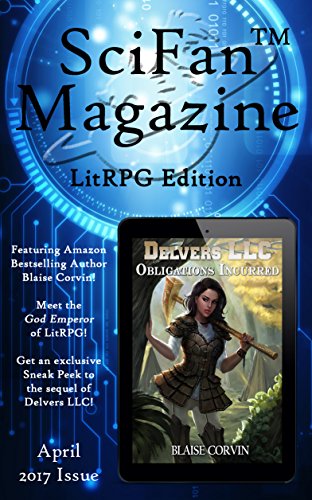
My story is entitled Control + Alt + Sadit, and it is a peripheral sequel to Act 1 of Immersion.

In addition to hosting a SPOILER commentary here later this evening, I will also be participating in the SciFan Author Takeover which I believe will take place here. My block will begin at 4EST/3CST for an hour and I'll be there to answer questions and post about this project, the revised edition of Immersion, as well as another project I'm developing for Royal Road.
Please stay tuned for more updates and in case this is your first visit to my infant blog, welcome ^_^.
Saturday, April 1, 2017
Journal Entry #1: The Vertical Mentality of LitRPG and the New Horizons yet to be discovered...
In Today's Journal Entry, I discuss the perception of LitRPG's growth in relation what I feel is integral to it reaching the next level. In addition to that I also briefly touch on my own intentions as an author of the genre and the philosophy I hope to contribute to the community. My worthless opinions are my own, but more importantly I'd love to hear yours.
To read the entry, click the "read more" link below!
To read the entry, click the "read more" link below!
Welcome to my blog!
I've been neglecting this site for a good month now due to rewrites but I'm going to attempt to start making regular posts again. Currently, my blog is going to be promoted in my author bio as a part of SciFan Magazine's LitRPG Quarterly so it's high time I begin putting content here for people to skim through.
Due to the nature of blogging, I'm going to try and avoid posts which would rely on me firing from the hip in a stream of consciousness. I tend to over-explain or overthink simple concepts so often times I'll write out thousands of words only to scrap the entire draft because I ended up drifting away from what I originally was trying to discuss, haha.
What I WILL be posting on this blog will consist of the following for now:
- Deleted or scrapped scenes from stories I've published - I write short stories so a lot of times that means that entire sequences are removed for sake of staying under a stringent word limit. While in many cases this is a good thing which removes redundancies or just self-indulgent filler, occasionally this will mean that some bits I really had fun writing just don't make the cut. In those cases I'll post drafts or entirely completed sequences here for sake of fleshing out content.
- Commentaries over story content that does get published- When it comes to indie writing, I've always held the belief that if you give a man enough rope he will eventually hang himself with it. Every measure I've taken to restrict or apply discipline on myself will not grant me amnesty from those pitfalls they will only prolong the inevitable fate of me hanging myself eventually, haha. Until then I want to provide at least some context as to where my head was at when I wrote what I did.
- Author Journals pertaining to decisions I’ve made in my writing style - I will always try and do things a little differently than other authors. Strangely enough, whenever I express my initiative to be different, many readers and writers in the LitRPG genre respond with apprehension. So I want to start writing brief journals outlining the various decisions I make and why it is I make them.
Anyway, that's it for now! Stay tuned because I’ll be posting throughout the week in preparation for the SciFan Quaterly launch this coming Friday, 4/7/2017. Follow the link provided above to pre-order.
Subscribe to:
Posts (Atom)